Showing posts with label genome sequencing. Show all posts

Friday, 21 February 2014

Pooping our way to a healthier tomorrow

Back in December we wrote about the human microbiota and how the microbiome contributes more to the human physiology than we think; disregulation of the microbiome has been linked to chronic C. difficile infection, diabetes, obesity, inflammatory bowel disease, Crohn's disease, and perhaps even autism. Altering the microbiome of affected individuals so that they resemble "healthy" individuals through fecal transplant has been shown to reverse the symptoms of many of these diseases showing that disorder is linked to a change of physiology due to changes in the microbiota (in fact, fecal transplant is more effective than antibiotics in treating chronic C. difficile). Before we go putting fecal transplant on a pede-stool, the scientists and the FDA are still debating how to regulate this bowel movement movement (it's a hard job, but somebody's got to poo it!).

Currently fecal microbiota is regulated as a biological, which means it has stricter control than some other substances and really bungs up both research and treatment of patients who could benefit from it (what a crappy situation). Scientists are arguing that fecal microbiota should be treated as a tissue or given it's own category, similar to what is done with blood.This would allow greater flexibility for both clinicians and researchers to poo what they gotta poo.

Microbiome research is one of the fastest emerging areas of research. Next generation sequencing is pushing this area of research to flush out our understanding of how the microbiome contributes to our physiology. NGS allows rapid analysis of mixed sequences to determine not  only the the species of microbes present, but the exact composition of a microbial community.

To support NGS workflows, Aurora offers the VERSA GENE, a complete walk-away solution for genomics workflows including NGS library preparation (grab your newspaper and take some time for yourself). The accurate liquid handling provides consistency between library preps and this open-system platform allows researchers to leverage different library preparation kits and chemistries available to fully realize everything that NGS can poo. At Aurora we believe that supporting science that can truly make a difference is not just a job, it's our doody!

Thursday, 28 November 2013

A Little Golden Nugget

A Little Golden Nugget

Pope Francis blessing a sample of Golden Rice in the Phillipines
          In North America we are lucky. For the most part we don't have to worry about where our next meal will come from, diseases associated with malnutrition are much more rare. This is not the case in the developing world where food security is still an issue of great concern. According to the Declaration of Human Rights put forth in 1948 by the UN "food security exists when all people, at all times, have access to sufficient, safe, and nutritious food to meet their dietary needs and food preferences for an active and healthy life". However, upwards of 250,000 to 500,000 children in the developing world go blind every year due to Vitamin A deficiency and up to half of these die from the condition. Vitamin A is found in many foods: carrots, spinach, mango, papaya, eggs and cheese, all of these foods can act as sources for Vitamin A, but lack of access to nutritious food drives the problem in many parts of the developing world.
 
World distributions of Vitamin A deficiency
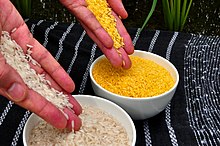
            In the early 2000's a potential solution was created: Golden Rice. The rice was genetically modified by a team in Switzerland to include the synthetic pathway of  a Vitamin A precursor. As rice is a staple food in many of the countries where endemic Vitamin A deficiency is a serious issue, this presented a viable solution. However, Golden Rice has faced much opposition throughout its development. Some fear that cultivation of Golden Rice will lead to wider acceptance and adoption of other GMO's, others argue that allowing corporate control of food production in this countries actually undermines food sovereignty and would help perpetuate the cycle of poverty. In either case, all the implications of adopting GMO products must be weighed against the potential benefits to society.
Golden Rice (right) compared to normal rice (left)
          Earlier this year Pope Francis blessed a sample of Golden Rice in the Philippines shortly after protesters destroyed a field of the grain. The benefits to mankind outweigh the negative aspects of this GMO crop which is why Pope Francis chose to bestow his blessing on it. Other GMO's act to add resistance to herbicide or disease, in general acting to benefit the farmer and not the consumer. In this case just the opposite is true, Golden Rice has been supported by a variety of NGO's and is designed to benefit the people and not put profits in the pockets of large corporations. As with adoption of any technology, the benefits must be weighed against the risks.
          Production of GMO's is a complicated and arduous process. Regardless of personal views of the risks and benefits of GMO's, thousands of brilliant scientists continue to work on developing new varieties; some may benefit the producers, some may benefit people, and some may only help to add to the bottom line of large corporations. Aurora's goal is to help the scientist, to expedite sample preparation in basic lab operations such as DNA extraction, PCR setup, and DNA sequencing efforts necessary for development of new crops whether they are created through genetic modification or conventional breeding programs. Automating the techniques associated with the scientific process helps to drive development cycle and bring new, beneficial products to market faster. To find out more about how Aurora helps drive various applications visit our webpage.

Find out more about Aurora: www.aurorabiomed.com

https://twitter.com/AuroraBiomedhttp://www.linkedin.com/company/aurora-biomedhttps://www.facebook.com/aurorabiomed9